Loved, Not Bought: Google Pixel's Ten-Year Experiment in Closing the Gap
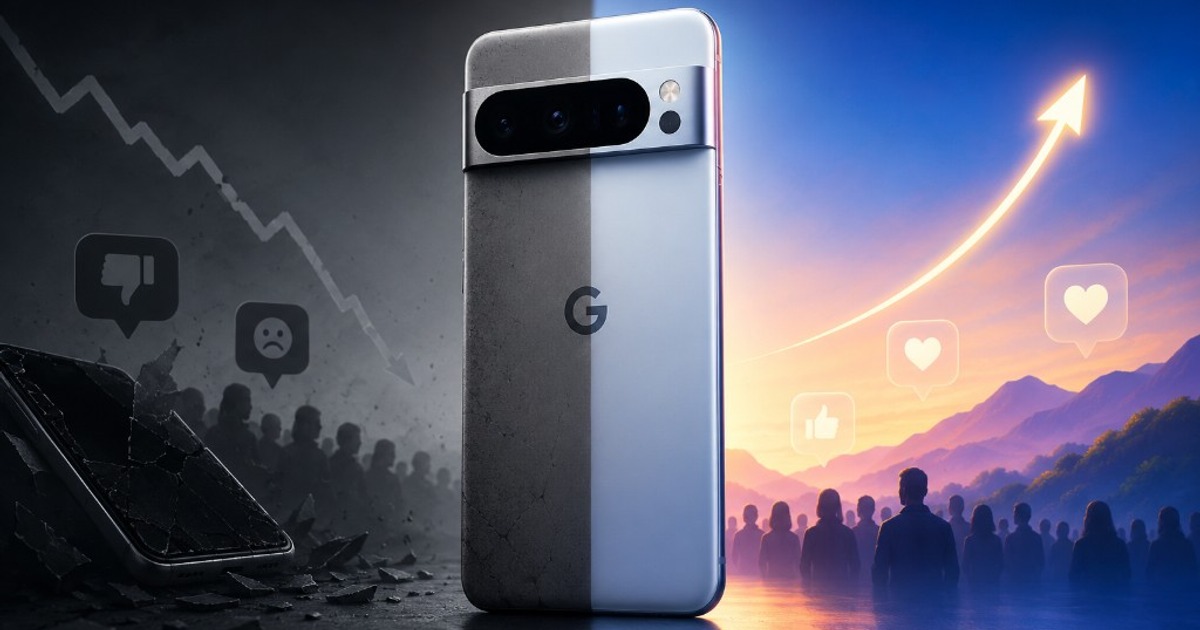
Google Pixel's ten-year arc looks like a redemption story. It reads more like a very expensive experiment in what was actually stopping people from buying a phone they already liked.
In October 2016, the camera lab DxOMark gave the first Google Pixel a score of 89, the highest it had ever awarded a phone. The Pixel beat the iPhone 7. It beat that year's reigning champion, Samsung's Galaxy S7. By DxOMark's own comparison, it scored higher than a professional Canon DSLR that sold for six thousand dollars. Google, a company that had never designed a camera module before, had built the best phone camera in the world on its first attempt.
If you actually wanted to buy that phone, you had a problem. In the United States it launched on Verizon, and nowhere else. In India it went up on Flipkart, and nowhere else: no counter to hold it at, no desk to visit if you cracked the screen, no financing plan, no salesperson who could explain why it cost what it cost. The best camera money could buy was, for most people, simply not a phone they could buy.
The story people tell about the Pixel now goes something like this: Google spent years making an unloved, half-finished product, and then, somewhere around the Pixel 6 or the Pixel 8, finally learned how to make phones, and people started buying them. It is a tidy arc. It is also not really what happened. Reviewers liked the Pixel's camera and software from the first generation onward, straight through the years everyone agrees were rough for Google's hardware division: the overheating Pixel 4, the underpowered Pixel 5, the buggy Pixel 6 launch. What was never really inconsistent was the affection. What was inconsistent was whether that affection could close the distance between a five-star review and an actual sale.
Look at what happened once Google started treating that distance as the actual problem.
Real growth off a low base
In the United States, Pixel's share of smartphone shipments sat at roughly 1 percent in 2021. By 2023, according to Counterpoint Research data reported by Android Authority, it had reached 4.6 percent, nearly quadrupling in two years off a genuinely low base. That is not nothing. It is also still a phone that ships behind Apple, Samsung, and, in some quarters, budget brands most Americans couldn't name.
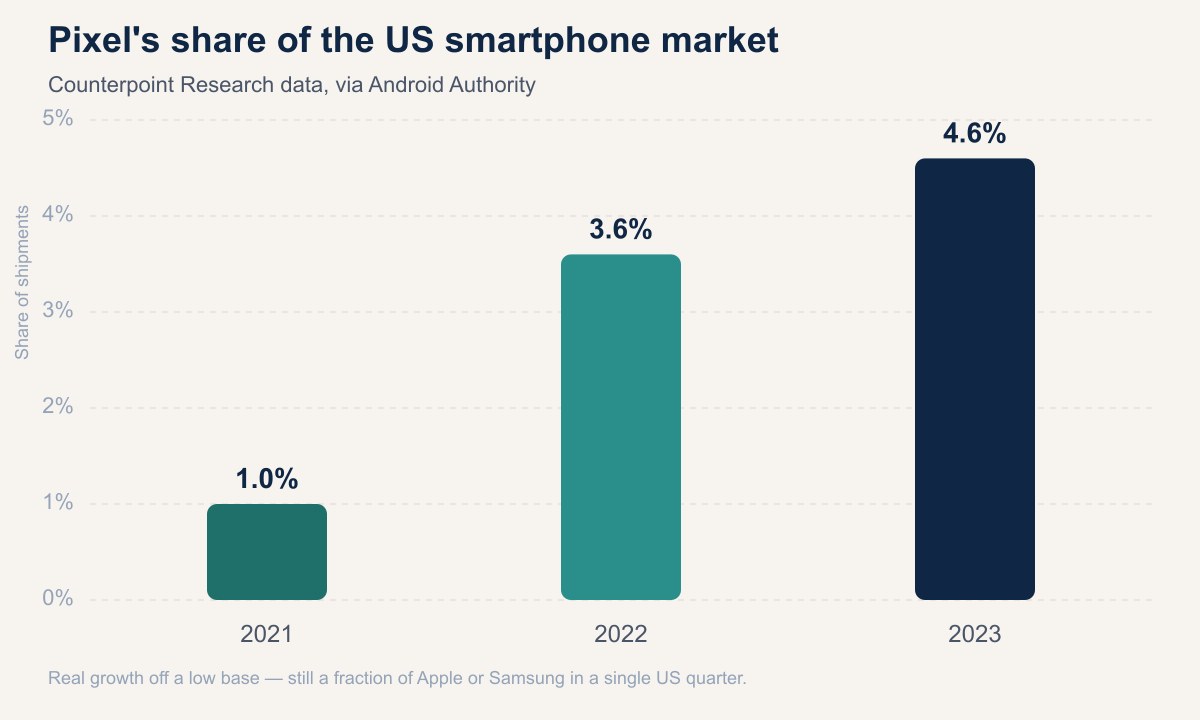
Pixel's share of the US smartphone market. Counterpoint Research data, via Android Authority. Real growth off a low base — and still a fraction of what Apple or Samsung ship in a single US quarter.
India's clearer experiment
The clearest version of this experiment, though, is India, and it rewards walking through slowly, because the sequence tells you what Google actually believed the problem was.
For most of its life in India, the Pixel was a Flipkart exclusive: an internet good, sold to the slice of buyers already comfortable ordering a seventy-thousand-rupee phone sight unseen. In August 2024, timed to the Pixel 9 launch, that changed. Google put Pixel devices into more than 150 Croma and Reliance Retail stores across 15 cities, and opened its own walk-in service centers in Delhi and Bengaluru, with Mumbai to follow, run jointly with Flipkart's own repair arm. That same month, Foxconn began assembling the Pixel 8 in India, the first Pixel to carry a "Made in India" stamp. None of this touched the camera, the chip, or the software. It touched the two things standing between someone who already liked the idea of a Pixel and an actual purchase: could they see and hold the phone somewhere, and could they trust that if it broke, someone nearby would fix it.
Within a year, Pixel's share of India's premium Android segment moved from 1 percent to 5 percent. The whole premium category was growing too, from roughly 4.2 million units shipped in the first three quarters of 2023 to about 6.5 million over the same stretch in 2024, so this wasn't a fight over a fixed pie. But the more interesting line on the chart belongs to someone else entirely.
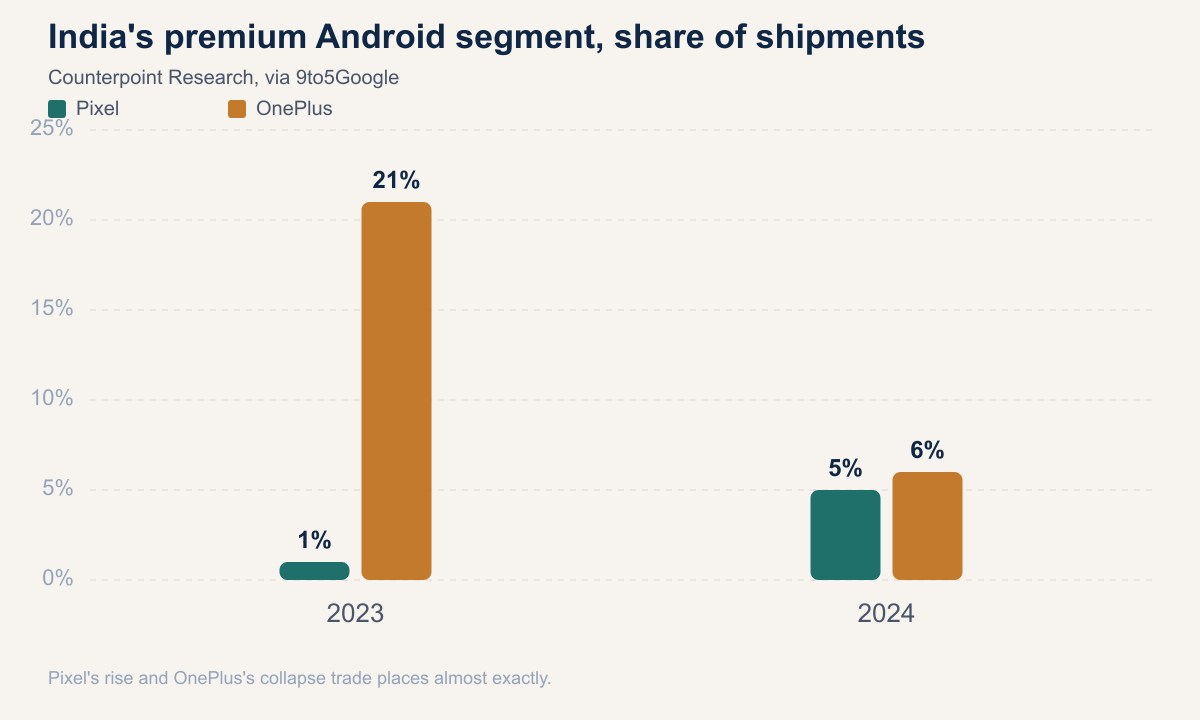
India's premium Android segment, share of shipments. Counterpoint Research, via 9to5Google. Pixel's rise and OnePlus's collapse trade places almost exactly. The timing is suggestive; OnePlus's own troubles inside BBK's brand portfolio did real work here too.
Google didn't stop at getting the phone in front of people. In December 2025 it launched the Pixel Upgrade Program in India: pay ₹3,333 a month on a 24-month no-cost EMI, and after nine payments (and before the fifteenth) you become eligible to trade up to whatever Pixel is newest, with the remaining balance on your old plan cleared by the finance partner and rolled into a fresh 24-month term. Run with Cashify, Bajaj Finance, and HDFC Bank, it bundles in trials of Google's own subscriptions on top.
There's a version of this that's just customer-friendly financing. There's another version worth sitting with: Google is now spending real money to make the purchase decision frictionless, which is a quiet admission that price, not preference, was doing a lot of the work in keeping people away.
Still living inside "Others"
Zoom out from India and the honest picture is that all of this is still happening at small scale. Global shipment data for 2025 puts Apple at roughly 20 percent, Samsung at 19 percent, Xiaomi at 13 percent. Pixel isn't big enough to earn its own line in most of these reports; it lives inside "Others," next to Nothing and a long tail of regional brands. Within that pile, Pixel had a genuinely good year, shipments up about 25 percent from 2024. It still wasn't enough to break out onto its own line on a major research firm's chart.
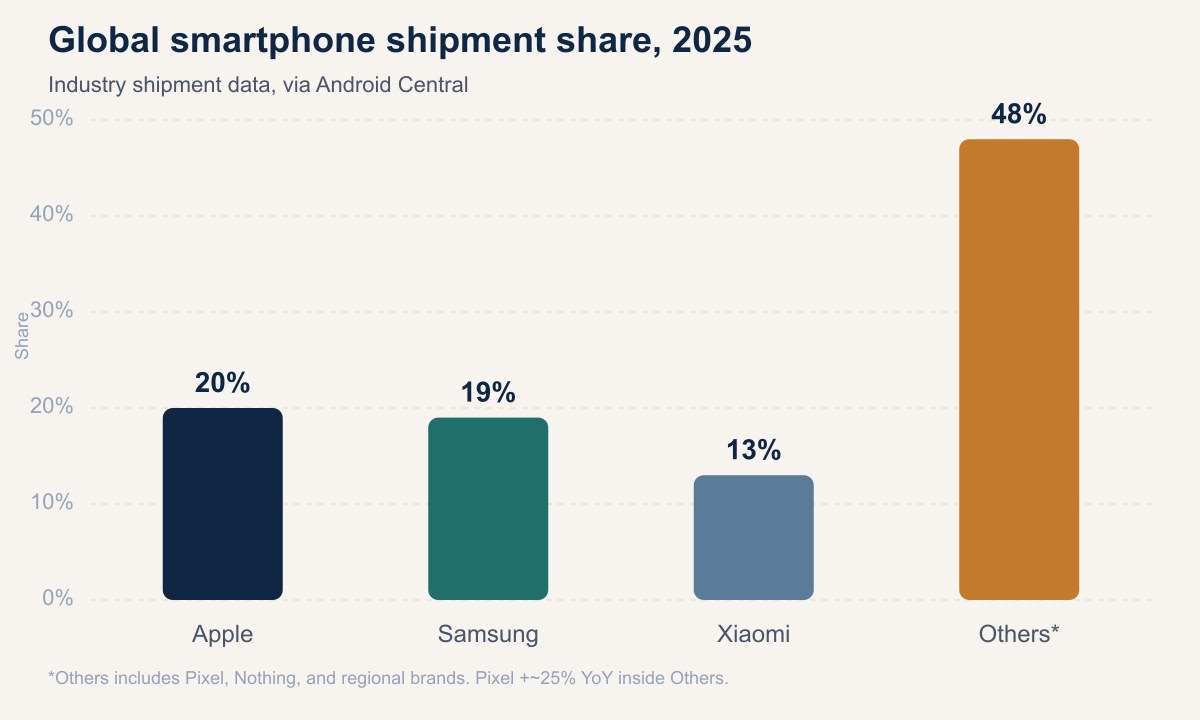
Global smartphone shipment share, 2025. Industry shipment data, via Android Central. "Others" includes Pixel, Nothing, and every regional brand large research firms don't break out individually. Pixel shipments grew roughly 25% year over year inside this group — still not enough to earn its own bar.
The second bet: Tensor and Gemini
There's a second bet running alongside the distribution one, and Google can only make it because it owns the software layer too. Since 2021, Pixel has shipped its own Tensor chip: the G1, debuting on the Pixel 6, built in Samsung's foundries and tuned less for benchmark speed than for running machine-learning models on the device itself. By the third generation, in 2023, Tensor manufacturing had moved to TSMC. By this year's fifth generation it had switched GPU vendors as well. Four hardware generations in, the pitch has shifted again, this time toward "Gemini Intelligence" as the organizing idea of the phone, rather than the camera or the chip. Google cannot out-manufacture Samsung's component supply chain, and it cannot out-integrate a decade of Apple's own silicon design. What it can do is make the AI features tied specifically to its own models the reason to pick this Android over any other one. That's a different kind of bet than "build a better camera." It's one only a company that also owns the model underneath can place.
The product still has to hold the ground
It would be a cleaner piece if the story stopped there. It shouldn't. The Pixel 11 Pro, reviewed the same week this was written, was described by 9to5Google as "a fine phone waylaid by narrative and circumstance," and the detail underneath that line is telling: HiLight, the headline feature meant to cut down how much people use their phones, shipped without support for messaging apps, which is where most phone use actually happens. Battery life is, in the reviewer's words, largely unchanged from the year before, despite a higher number on the spec sheet. Android Central's read on Pixel's whole 2025 was that it had "a good year" that "still trails the big phone makers." Five Tensor generations in, the chip that was supposed to be Pixel's structural advantage hasn't resolved the complaints that have followed the line since the Pixel 6: heat, battery, a real gap against Snapdragon and Apple silicon on raw performance.
So which version of the Pixel story is true: a phone that spent a decade being loved by the people who actually tried it, and finally found a way to reach everyone else, or a phone Google is now paying, quarter after quarter, to keep relevant, through retail build-outs, EMI plans, and a chip strategy that still hasn't fully delivered? Probably some of both, in proportions nobody outside Google's own sales data actually knows. What seems true either way is that "hated to loved" gives Google too much credit for a change in taste and not enough for a change in spending. The Pixel already gets the good reviews; it has for a decade. The open question for the next few years isn't whether critics keep liking it. It's whether Google keeps paying to close the gap between the phone people say they'd buy and the phone people actually do, or whether, at some point, the product has to hold that ground on its own.
At a glance
Notes & sources
- Pixel 1 DxOMark score of 89 and comparisons to iPhone 7, Galaxy S7, and a $6,000 Canon DSLR: Android Authority, 2016.
- US Pixel market share, 1% (2021) to 4.6% (2023): Android Authority, citing Counterpoint Research.
- India retail expansion: 150+ Croma/Reliance Retail stores across 15 cities, walk-in service centers: Business Today, August 2024.
- Locally-assembled Pixel 8 in India (Foxconn): TechCrunch, August 2024.
- India premium-segment share: Pixel 1%→5%, OnePlus 21%→6%, 2023–2024: 9to5Google, January 2025, citing Counterpoint Research.
- Pixel Upgrade Program, India (December 2025 launch, terms): Techlusive and 9to5Google.
- Global 2025 shipment share (Apple 20%, Samsung 19%, Xiaomi 13%, Pixel +25% within "Others"): Android Central.
- Tensor chip generations and foundry history (G1–G5): Wikipedia, Google Tensor.
- Pixel 11 Pro review, "waylaid by narrative and circumstance," HiLight and battery notes: 9to5Google, August 2026.
- The framing question, "the best phone almost no one buys," is drawn from the Washington Post's August 2025 piece on Pixel's reception versus its sales; the site declined direct verification of its exact figures during research for this piece, so its precise numbers aren't repeated here. Washington Post, August 2025.
Ready to join the thinking revolution?